
There was a moment — maybe you’ve had one too — where you tried something new, stumbled, and heard a voice in your head say: “See? You’re just not the type of person who’s good at this.” Learning how to build a growth mindset starts with recognising that voice for what it is.
That voice? That’s not the truth. That’s a fixed mindset doing what it does best: protecting you from discomfort by keeping you small.
The good news is that voice is not permanent. And science has actually proven it.
In 2006, Dr. Carol Dweck of Stanford University published research that changed how the world understood human potential. Her finding was both simple and revolutionary: people who believe their abilities can be developed — through effort, strategy, and guidance — achieve more than people who believe their abilities are fixed. She called this a growth mindset.
But here’s the part most articles skip: knowing what a growth mindset is and actually building one are two completely different things.
This guide gives you both. You’ll understand exactly what a growth mindset is and why it matters — and you’ll walk away with a practical, step-by-step framework for actually developing one in your daily life. If you’re new here, start your journey here — and explore all our mindset articles for the full library.
What Is a Growth Mindset?
A growth mindset is the belief that your intelligence, abilities, and talents are not fixed traits — they can be developed through dedication, hard work, and a willingness to learn.
This concept, first introduced by psychologist Carol Dweck, sits at the opposite end of the spectrum from a fixed mindset — the belief that you either have a talent or you don’t, that intelligence is something you’re born with, and that failure is proof of your limitations.
Quick Answer: A growth mindset is the belief that abilities and intelligence can be developed through effort, learning, and persistence. Coined by psychologist Carol Dweck at Stanford University, it contrasts with a fixed mindset, which assumes talent is innate and unchangeable. People with growth mindsets embrace challenges, learn from failure, and view effort as the path to mastery.
Growth Mindset vs. Fixed Mindset — The Core Difference
The easiest way to understand the growth mindset is to compare it directly to the fixed mindset. Both mindsets live in all of us — often at the same time, in different areas of life.
| Situation | Fixed Mindset Response | Growth Mindset Response |
|---|---|---|
| You fail at something new | “I knew I wasn’t good at this” | “What can I learn from this?” |
| Someone gives critical feedback | Defensive, dismissive | Curious, asks follow-up questions |
| You see someone else succeed | Threatened, envious | Inspired, asks how they did it |
| A task is harder than expected | Give up or avoid it | Double down, seek help |
| You make a mistake | Shame, hide it | Acknowledge it, correct course |
| Complimented on talent | “Thanks, I’m naturally gifted” | “Thanks, I worked really hard on this” |
| Learning something new | Expect to be good immediately | Expect and embrace a learning curve |
| Your plan doesn’t work | “This will never work” | “Let me try a different approach” |
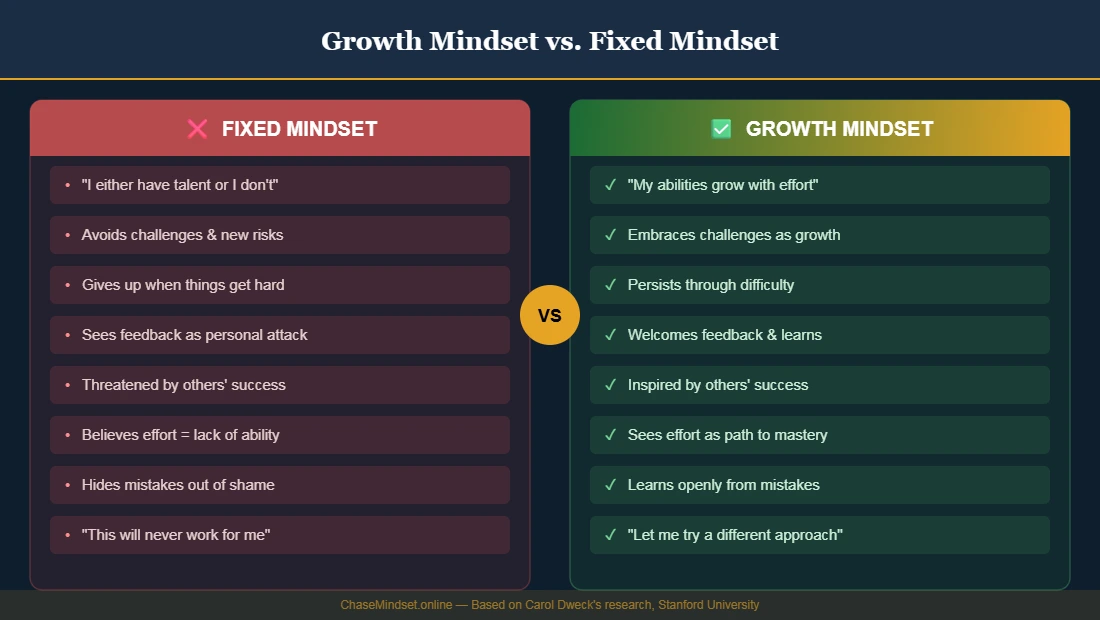
The right column isn’t just positive thinking. It’s a fundamentally different relationship with effort, failure, and learning — and it’s a relationship you can build, starting today. For a deeper dive into this distinction, explore our full guide on growth mindset vs. fixed mindset.
Signs You Might Have a Fixed Mindset Right Now
Before you can build a growth mindset, you need to recognize where the fixed mindset is showing up. Most people don’t think “I have a fixed mindset” — it shows up quietly, in specific situations. Be honest with yourself:
- You avoid challenges because you don’t want to look incompetent
- You give up quickly when something is harder than expected
- You feel defensive or hurt when receiving feedback
- You hide your mistakes rather than learning from them
- You feel threatened when a friend or colleague succeeds
- You believe you’re “just not a creative / mathematical / organized person”
- You put in less effort because “effort won’t change things”
- You feel like you need to prove yourself constantly
- You interpret setbacks as permanent, not temporary
- You avoid trying new things because failing would be embarrassing
If you checked three or more of those, you’re not broken — you’re human. Fixed mindset patterns are deeply conditioned, often from childhood, and recognizing them is the first step to changing them. Our guide on how to overcome a fixed mindset walks you through it step by step.
The Science Behind the Growth Mindset
This isn’t pop psychology. The growth mindset is grounded in decades of rigorous research — and what neuroscience has discovered about the brain only makes the case stronger.
Carol Dweck’s Research at Stanford
Dr. Carol Dweck and her team at Stanford University spent over 30 years studying how people respond to challenges, failure, and feedback. In one landmark study, students praised for their intelligence (fixed mindset praise) chose easier subsequent tasks to protect their image. Students praised for their effort (growth mindset praise) chose harder tasks and improved their scores by an average of 30%.
The takeaway: how we talk about effort and ability shapes future behavior in measurable, quantifiable ways.
Neuroplasticity — Your Brain Can Actually Change
The deeper scientific foundation for the growth mindset is neuroplasticity — the brain’s ability to reorganize itself by forming new neural connections throughout life. For decades, scientists believed the adult brain was essentially fixed. We now know that’s wrong.
Every time you push through a challenge or learn something new, you are literally changing the physical structure of your brain. This means:
- A skill you’re bad at today can become a strength with focused practice
- Fear responses can be rewired through repeated exposure
- Thought patterns — even deeply ingrained ones — can be changed
The growth mindset isn’t just a metaphor. It’s biologically real.

Why Building a Growth Mindset Is Hard (And Why That’s Normal)
If a fixed mindset is what keeps stalling you, read how to overcome a fixed mindset first. It explains why the usual advice about arguing with your inner voice tends not to work.
If growth mindsets are so powerful, why doesn’t everyone simply have one? Because the brain hates uncertainty — and growth requires uncertainty.
The fixed mindset is, in part, a survival mechanism. The brain’s threat-detection system (the amygdala) doesn’t distinguish between social threats (embarrassment, criticism) and physical threats. They feel the same. So when you’re about to try something hard, your brain genuinely interprets it as danger and tries to protect you — by making you procrastinate, avoid, or quit.
Building a growth mindset means deliberately overriding this mechanism, repeatedly, until new neural pathways form. It’s not about willpower — it’s about repetition and strategy. That’s exactly what the next section gives you.
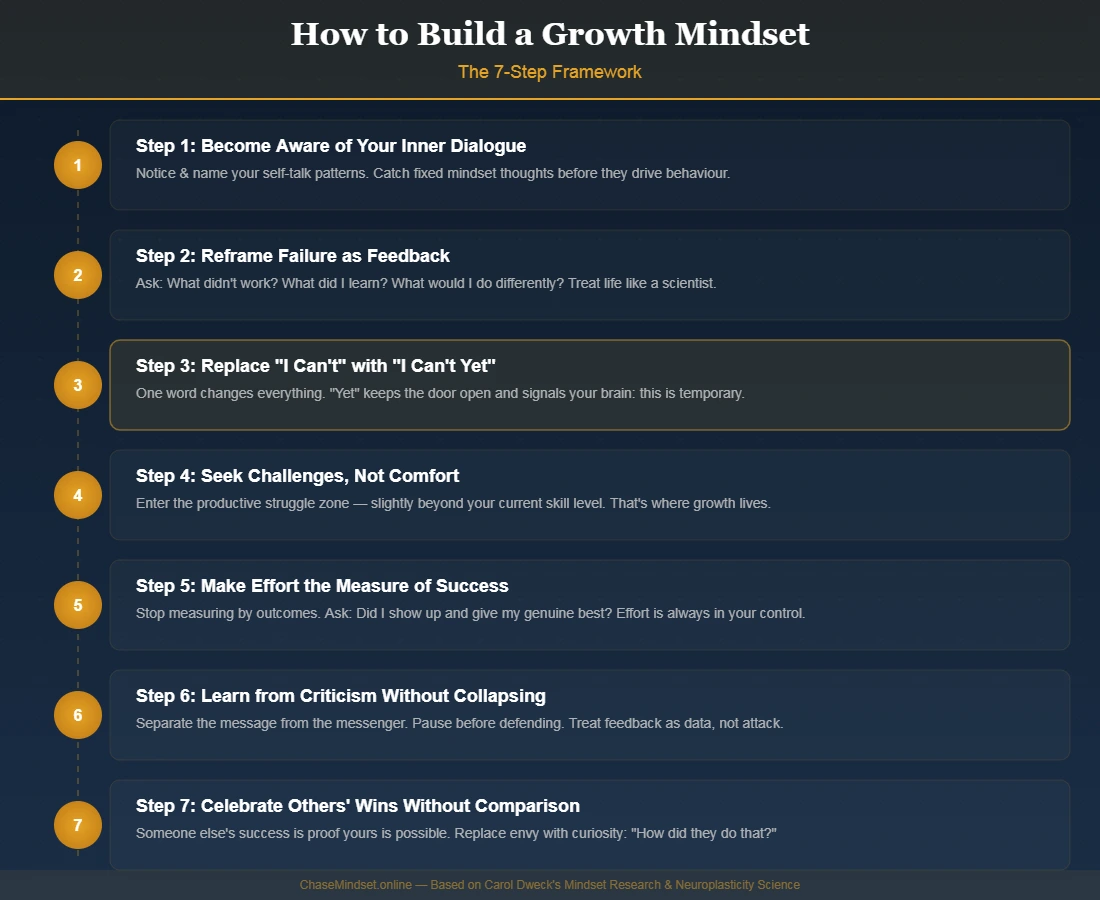
How to Build a Growth Mindset — The 7-Step Framework
This isn’t a list of vague tips. This is a concrete, ordered system — each step builds on the last.
Step 1: Become Aware of Your Inner Dialogue
You cannot change a thought pattern you can’t hear. The first step is developing the habit of noticing your self-talk — specifically, the stories you tell yourself when things get hard.
- Start a mind journal. When you feel resistance or self-doubt, write down the exact thought. Don’t edit it.
- Look for patterns. When do these thoughts appear most? Around work? Relationships? New skills?
- Label the thought. “That’s my fixed mindset talking.” Naming it creates distance from it.
This week’s practice: At the end of each day, write down one moment where you had a fixed mindset response. Just observe — no judgment yet.
Step 2: Reframe Failure as Feedback
People with a growth mindset don’t enjoy failure any more than anyone else. They just have a different relationship with what failure means.
In a fixed mindset, failure = “I am not capable.” In a growth mindset, failure = “That approach didn’t work. What data does this give me?”
After any setback, ask yourself three questions: What specifically didn’t work? What did I learn from this? What would I do differently next time? This reframe is especially powerful for anyone who is chasing their dreams — because the path to anything meaningful is paved with failure. The sooner you make peace with that, the faster you move.
Step 3: Replace “I Can’t” With “I Can’t Yet”
This one tiny word change is backed by actual research. Dweck’s studies showed that students who added “yet” to statements like “I don’t understand this” performed significantly better over time. The word “yet” keeps the door open. It tells your brain: this is a temporary state, not a permanent truth.
Catch yourself using finality language — “I’m not good at this,” “I can’t do this” — and add “yet.” Then ask: What would it take to get there? That question is the action plan.
Step 4: Seek Challenges, Not Comfort
People with a fixed mindset gravitate toward things they’re already good at. Growth mindset people do the opposite — they seek out what psychologists call the “productive struggle” zone”: slightly beyond their current capability.
Psychologist Mihaly Csikszentmihalyi’s research on flow found that the optimal challenge-to-skill ratio is slightly above your current ability — not overwhelmingly hard, not boringly easy. That sweet spot is where growth lives. Identify one area of your life where you’ve been playing it safe, and take one step beyond it this week.
Step 5: Make Effort the Measure of Success
Stop measuring success by outcomes and start measuring it by effort. Effort is the only thing you have complete control over — and it’s the most reliable predictor of long-term success.
At the end of each week, don’t ask “Did I achieve my goal?” Ask: “Did I show up and give my genuine best effort?” Celebrate effort-based wins: “I studied for 90 minutes even though I didn’t want to.” This is a cornerstone of joyful living — finding meaning in the process, not just the destination.
Step 6: Learn from Criticism Without Collapsing
Criticism is information. Most people — raised in fixed mindset environments — experience criticism as an attack on their identity. The growth mindset treats it as data.
When you receive feedback, pause before responding. Ask: “Is there truth in this, even if I don’t like how it was delivered?” Separate the message from the messenger. Practice saying: “Thank you — let me think about that.” Not all criticism is valid — but dismissing it all protects your ego at the cost of your growth.
Step 7: Celebrate Others’ Wins Without Comparison
In a fixed mindset, someone else’s success feels like evidence of your own inadequacy. In a growth mindset, someone else’s success is proof that what you want is achievable.
When you feel a sting of envy, notice it without shame — envy is a signal, not a flaw. Then ask: “What is this person’s success showing me is possible?” Replace comparison with curiosity. Reach out to people ahead of you. Learn their path. This shift also transforms your relationships — you become someone people want to be around.
Daily Growth Mindset Habits — The 30-Day Practice Plan
Building a growth mindset isn’t a one-time decision. It’s a daily practice — like exercise for the brain. Here’s a structured 30-day plan where each week’s habits build on the last.
Once you have the framework, the next step is putting it to work. We have collected 25 growth mindset activities — each with exact steps, a time cost, and a note on how it usually goes wrong.
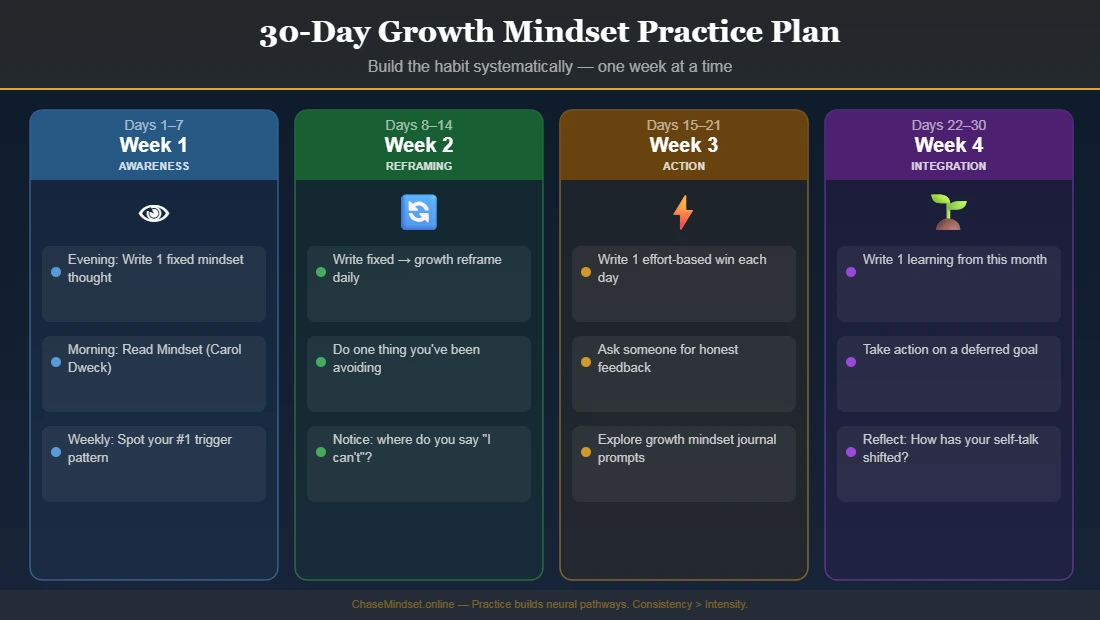
Week 1: Awareness (Days 1–7)
Daily habit: Take 5 minutes each evening to write one fixed mindset thought you caught that day. Just notice — no judgment. Morning habit: Read one paragraph from Mindset by Carol Dweck before picking up your phone. Weekly reflection: What’s the most common trigger for your fixed mindset?
Week 2: Reframing (Days 8–14)
Daily habit: For every fixed mindset thought you catch, write its growth mindset reframe. Fixed: “I’m terrible at public speaking.” → Growth: “I’m still learning how to speak confidently. What’s one thing I can practice?” Challenge: Do one thing this week you’ve been avoiding because you were afraid of not being good at it.
Week 3: Action (Days 15–21)
Daily habit: Write one effort-based win from each day. “I kept going even when it was hard.” “I asked for help instead of quitting.” Challenge: Ask one person for honest feedback on something you’re working on — and practice receiving it without defensiveness. Explore our growth mindset journal prompts for deeper reflection this week.
Week 4: Integration (Days 22–30)
Daily habit: Write one thing you’re grateful for learning this month — even if it came from a mistake or setback. Challenge: Identify one goal you’ve been putting off because “you’re not ready yet.” Take one concrete step toward it this week. Explore our lifestyle and joyful living content to find daily practices that support your mindset work outside this plan.
Growth Mindset in Real Life — Examples That Make It Click
Example 1: The New Job
Fixed mindset: You take a new role, feel overwhelmed in month one, and start wondering if you made a mistake. You keep quiet in meetings, avoid asking questions, and fake confidence you don’t have.
Growth mindset: You take the same role, feel the same overwhelm, and think: “This is hard because it’s new, not because I’m wrong for it.” You ask questions. You tell your manager what you’re learning. You see the steep curve as evidence that this job is growing you.
Example 2: Starting a Blog or Creative Project
Fixed mindset: You publish your first piece, get almost no engagement, and conclude you don’t have what it takes. You stop.
Growth mindset: You publish the same piece, get the same result, and ask: “What did the content that does get engagement do differently?” You study it. You adjust. You keep going. This is exactly the ChaseMindset approach — building this content library one powerful piece at a time.
Example 3: A Difficult Relationship
Fixed mindset: An argument ends badly. You decide that’s just how you are — bad at conflict, bad at communicating. You withdraw.
Growth mindset: The same argument ends badly. But you approach the person later and say: “I think I handled that badly. Can we try again?” You treat conflict as a skill you can get better at navigating.
Growth Mindset Affirmations and Journal Prompts
10 Growth Mindset Affirmations
These aren’t toxic-positivity statements — they’re honest reframes rooted in the science of growth. Say them aloud, write them, or use them as mantras when your inner critic gets loud:
- “My abilities are not fixed — I am always capable of learning and improving.”
- “Effort is not a sign of weakness. It’s the path to mastery.”
- “I don’t need to be perfect to be worthy of trying.”
- “Failure is feedback, not a final verdict.”
- “I can’t do this yet — and yet is not the same as never.”
- “Other people’s success doesn’t diminish my own potential.”
- “I am not the same person I was a year ago. Growth is already happening.”
- “Challenges don’t reveal my limitations. They reveal my next level.”
- “I show up fully even when I don’t know how it’ll turn out.”
- “My brain is changing every time I choose to keep going.”
For a full library of 100 affirmations, visit our growth mindset affirmations guide.
10 Growth Mindset Journal Prompts
- What’s one belief I hold about myself that might actually be a story, not a fact?
- When was the last time I surprised myself by doing something I thought I couldn’t?
- What would I do if I knew I couldn’t fail? What’s stopping me from doing it anyway?
- Who in my life do I admire for their growth mindset? What specifically do they do differently?
- What failure in my past has actually taught me the most?
- In what area of my life am I playing it safest right now? Why?
- What does “not yet” mean for my biggest dream right now?
- What criticism have I been avoiding listening to that might actually be true?
- What would I tell a younger version of me about failure and learning?
- How have I grown in the last 12 months — even in ways that are hard to see?
Explore our full set of 50 growth mindset journal prompts for deeper daily reflection.
Common Mistakes When Building a Growth Mindset
Mistake 1: Thinking It’s Just About Positivity
A growth mindset is not toxic positivity. It doesn’t mean pretending everything is fine. It means remaining open even when things are hard. There’s a difference between “Everything is great!” and “This is hard, and I’m going to keep going.”
Mistake 2: Trying to Apply It to Everything at Once
Start with one area — career, relationships, health — and build there first. Consistency in one domain beats scattered effort across ten.
Mistake 3: Effort Without Reflection
Growth mindset isn’t “try harder, try harder.” It’s “try, reflect, adjust, try again.” Make sure your effort is informed by honest assessment of what’s working and what isn’t.
Mistake 4: Expecting the Inner Critic to Go Away
It won’t. Even the most growth-oriented people have a fixed mindset voice. The goal isn’t silence — it’s not letting it make decisions for you. You hear the voice, acknowledge it, and act anyway.
Mistake 5: Only Reading About It, Never Practicing It
Information alone doesn’t change the brain — experience does. The 30-day plan, journal prompts, and daily reframes above are the practice. Reading is the warm-up.
Frequently Asked Questions About Building a Growth Mindset
Can adults actually build a growth mindset?
Absolutely. Adults can build a growth mindset at any age. Neuroplasticity means the brain retains the capacity to form new patterns throughout life. The process requires more deliberate effort for adults, but it’s entirely achievable. Our guide on growth mindset for adults covers this in depth.
How long does it take to build a growth mindset?
Most people experience meaningful shifts in their self-talk within 2–3 weeks of consistent daily practice. Deeper integration typically takes 30–90 days of focused effort. Building a fully integrated growth mindset is a lifelong practice — but early results come faster than most people expect.
What’s the difference between a growth mindset and positive thinking?
Positive thinking tells you to believe things will work out. A growth mindset tells you to believe you can make things work out through effort and learning — even when the outcome is uncertain. Growth mindset acknowledges difficulty rather than denying it.
Can you have both a growth mindset and a fixed mindset?
Yes — and most people do. You might have a genuine growth mindset around your career but a fixed mindset around your relationships or creativity. The work is identifying where the fixed mindset is most limiting you and choosing to respond differently in those areas first.
What triggers a fixed mindset most often?
Common triggers include high-stakes situations, public performance or judgment, criticism from someone whose opinion matters to you, and social comparison — especially on social media. Knowing your triggers is the first step to managing them (see Step 1 of the framework above).
Does a growth mindset actually improve performance?
Yes — extensively. Dweck’s research across students, athletes, and business professionals consistently shows that growth mindset beliefs correlate with higher achievement, greater resilience, and more positive responses to failure. It’s one of the most well-replicated findings in psychology.
What’s the best book to learn about growth mindset?
Mindset: The New Psychology of Success by Carol Dweck is the foundational text. For applying the principles to daily habits, Atomic Habits by James Clear is an excellent companion. Check our best books for growth mindset guide for more options.
What is the connection between growth mindset and resilience?
They’re deeply linked. Resilience — the ability to recover from setbacks — is largely a product of how you interpret failure. A growth mindset reframes failure as temporary and informative, which makes recovery faster and more deliberate. Explore our guide on building resilience for the full connection.
Your Growth Mindset Journey Starts Here
Here’s the honest truth: you will not build a growth mindset by the time you finish this article. That’s not how it works.
What you can do — right now, in the next five minutes — is take the first step. Choose one: open your notes app and write down one fixed mindset thought you’ve been carrying, then write its growth mindset reframe. Or pick one day from the 30-day plan above and commit to starting tomorrow. Or join the ChaseMindset newsletter — weekly content on mindset, intentional living, and building a life worth chasing, delivered free to your inbox.
Every person who has ever done something remarkable started exactly where you are right now. They didn’t wait until they felt ready. They started — imperfectly, uncertainly, bravely.
Enjoyed this article? Explore more of what we’re building in the Mindset, Joyful Living, and Chasing Dreams sections of the blog. And grab our free resources to keep the momentum going.